
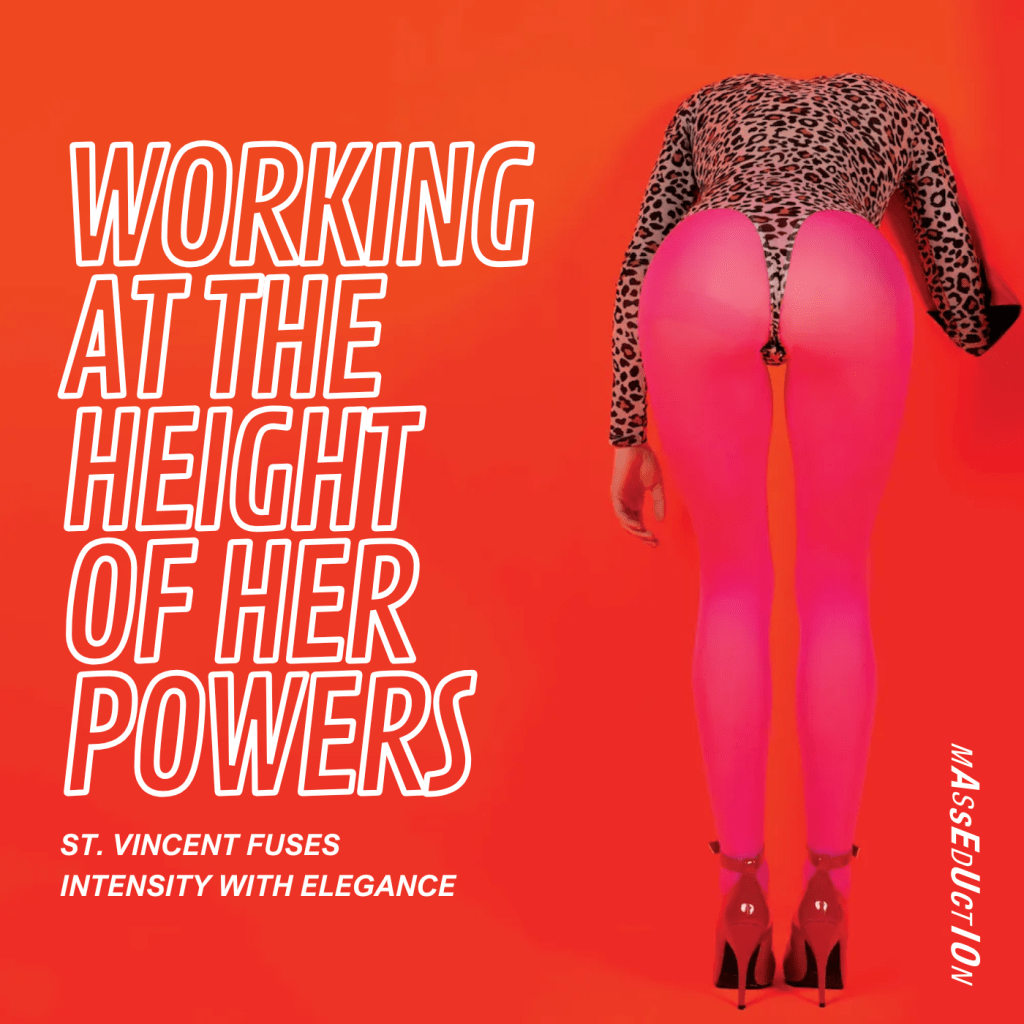
‘Masseduction’ serves as the fifth studio album by Annie Clark, known professionally as St. Vincent. From my first listen, it’s a powerful amalgamation of sound and emotion that has explosively landed in the contemporary indie-rock sphere. Wer’e graced with a colorful and energetic release that firmly situates Clark at the height of her musical powers.
The album, characterized by its retro influences, was primarily crafted from voice notes on Clark’s iPhone, a method that may explain the album’s scattered structure and dramatic tempo shifts. With this artistry, Clark retains the fractured beauty of her musical roots, exploring themes of power, sex, drugs, sadness, relationships and, well, death all through her clever blend of futuristic pop, new wave, psychedelic pop, dream pop, glam rock, and electronica. A whirlwind of a release. We’ve got a lot to discuss.
Clark opens the album with Hang on Me, a track that delves into the theme of co-dependence. The track serves as a bridge from her previous self-titled album, featuring recognizable swooping synths and distorted guitars. These elements are staples of St. Vincent’s world, and show evidence of her continued motif already. There is a sense of unbelonging in this track, emphasized by deliberate clashes with the main melody, and sweet falsettos delivering the line, ‘you and me were not meant for this world’. The sense of co-dependence is further accentuated by the sound effects of church bells, suggesting wedding vows, and choral strings that add a classical touch.
The rhythmic track Pills is a already a standout on the album, exploring issues and pressures from touring and drug-use. Opening with a chant in a nursery-rhyme fashion, ‘pills to wake, pills to sleep, pills, pills, pills, every day of the week’, the track contrasts its innocent sound with stark lyrics about addiction. Slurred verses and a tripped-out chorus conveys an essence of addictiveness and this is complemented by how catchy the song actually is. The fast pacing of the track mimics the effects of drugs, with steel pans bouncing off left and right stereo inputs, alluding to a disorienting state.
Through vivid imagery, Clark highlights society’s dependence on pills for daily rituals and coping mechanisms, stressing this in the vivid line, ‘Pills to fuck’. The messy bridge, filled with distorted guitars and trumpets, of all things, is really reminiscent of Clark’s past collaboration with David Byrne and an influence we see shared throughout this album. A really dynamic track, with its earnest reflective stance and powerful message, leaves a lasting impact on us.
The title track, Masseduction, features a childish Japanese opening (which translates as to ‘power corrupts’) that grows in intensity, creating a robotic feel. This track tackles issues of corruption and power, whether political or social. The opening line, ‘black saint, sinner lady playing knockoff soul’, highlights the complexity of human behaviors and the difficulty in controlling them to be genuine. This is furthered emphasised in the repeated call-and-response chorus, ‘I can’t turn off what turns me on’. The track’s digital touchpad elements add to this industrial feel too.
Sugarboy delves into the desire for sweetness, whether in age or innocence. It radiates a lustful feel, with slow and clingy-type lyrics such as ‘sugarboy, I’m in need’, which contrast against the fast-paced driving rhythm, creating a sense of chasing somehow. The slow-motion chorus presents itself in a melodramatic way while the pre-chorus features snappy, staccato notes sung in a lower octave. Clark’s expression of her bisexuality in this one is evident, directing the first verse to a ‘sugarboy’ and the second to a ‘sugargirl’. To finish, the up-tempo outro features chants of ‘boys’ and ‘girls’ dissolving into an 8-bit retro sound, adding to the album’s thematic complexity.
In Los Ageless, Clark expresses her views on Los Angeles, a city she encountered after moving from New York. The explosive, colorful track plays on the city’s name to emphasize its everlasting and artificial nature. Innuendos like ‘In Los Ageless, the women never come’ and extended metaphors such as ‘they build and build until you have no escape’ critique the city’s rapid growth and entrapping nature. Hollywood ain’t all that anymore. The personification of the city in the triplet chorus, ‘how can anybody have you?’ evolves into a commentary on the city’s mental impact, ending with the haunting line, ‘I try to tell you I love you but it comes out all sick’, subtly warning us the city’s chokehold on society in the 21st century.
Acting as the turning point, or volta if you will, Happy Birthday, Johnny transitions us seamlessly to a piano ballad that explores themes of loss. Clark reflects vividly with lyrics like ‘yelled through your teeth’ suggesting aggression and that the mysterious “Johnny” could be behind bars. This is hinted again in the outro, where Clark finishes with ‘when you get free, Johnny, I hope you find peace’. A mysteriously moving ballad.
Saviour is a funk-filled track with sexual connotations and religious undertones. The simplistic yet joyful instrumental and paired bassline create an engaging listening experience. It’s the hardest hitting one yet. Punchy beats and sharp backing vocals give the track a sense of steadiness, transitioning into a powerful chorus with repeated angelic pleas of ‘please’. I can see this melody itself being a core memory from this release. The song’s transition from shy funkiness to a powerful hit highlights the importance of saving someone, adding depth and responsibility to the album’s themed narratives.
The prominent piano in New York really captivated this as the first single release from this era. It’s a poetic tribute to Clark’s hometown. With references to ‘5th Avenue’ and ‘Astor Place’, Clark contrasts New York with Los Angeles, expressing her preference, naturally, for the former. The track’s addresses co-dependence again, declaring her lover the ‘only motherfucker in the city who can stand me’. The explicit term carries a strong flavour to it in order to highlight the depth of her affection. Despite its short duration, this one really packs a significant emotional punch.
Becoming more and more furitistic in production, Fear the Future is driven by technological influence. Distorted guitars and synths accompany Clark’s strong, auto-tuned vocals, creating an innovative feel. The track’s explosiveness stresses the worries about the future and the personification of the future as a ‘monster’ exaggerates this further. The back-and-forth synths disruptively underscore the song’s theme, ending suddenly to potentially warn us about life’s overwhelming nature and how sudden it can establish itself.
Young Lover serves as a thematic sister to ‘Sugarboy’, exploring a young relationship with a sense of desire with tragic consequences. The panicked response to death in the line, ‘young lover, begging you please to wake up’, highlights her lover’s overdose and the crunchy, slashing guitars accompanied by hysteric screeches in the final chorus emphasise this harsh realisation and hopelessness. Yikes. It’s an intense listen.
Can you have a melancholic dance anthem? Slow Disco exists to believe so. A nod to lost loves, this one has a slow tempo and relaxing sound, but filled with melancholic lyrics like ‘there’s blood in my eyes’ and ‘dancing with a ghost’ to add to this theme of loss. Clark quotes in an interview that “there’s a life we are supposed to live and there’s our own life, being haunted by that supposed ideal lifestyle” and I think that’s the perfect way to describe this one. I couldn’t try and put it better.
The final track, Smoking Section, is another melancholic ballad that defies conventional song structures. Beautiful vocal cracks and expressive lyrics, ‘and when you stomp me out’, personify a cigarette’s final moments, reflecting Clark’s despair and hopelessness that we have seen unravel in the last few tracks. It has a gospel-like quality that emits a resolving feel and a piano sees us out.
This is probably one of the most complex, bleak, and gorgeously chaotic albums I’ve listened to. ‘Masseduction’ solidifies St. Vincent’s place in contemporary music and the indie rock market, and she does this through her most complex work. It’s energetic, it’s melancholic, it’s explorative, it’s a commentary on society, it’s a struggle. But that’s what makes it one of the best.
 Glerbie