
I’ve been a fan of Lana Del Rey since her debut, but when I saw she was working with Jack Antonoff (lead singer of Bleachers and the most wanted producer right now), I knew this release was going to be something bold, new, and really really special. And guess what? It really, really is.
‘Norman Fucking Rockwell’ is a cinematic exploration of love, lust, and the intricate layers of modern American culture. With Antonoff’s lush production, this album takes listeners on a journey through the beauty and pain of everyday life while quietly critiquing the flaws of a failed Americana. It’s her most introspective piece yet, and it feels like a healing body of work compared to previous releases.
With a nod to the actual Norman Rockwell, an iconic painter of Americana who addressed once-controversial themes like poverty and racism in the 60s, Lana captures the complexity of modern American life with grace and depth, making this her most poignant and personal album yet. Let’s fucking! go…
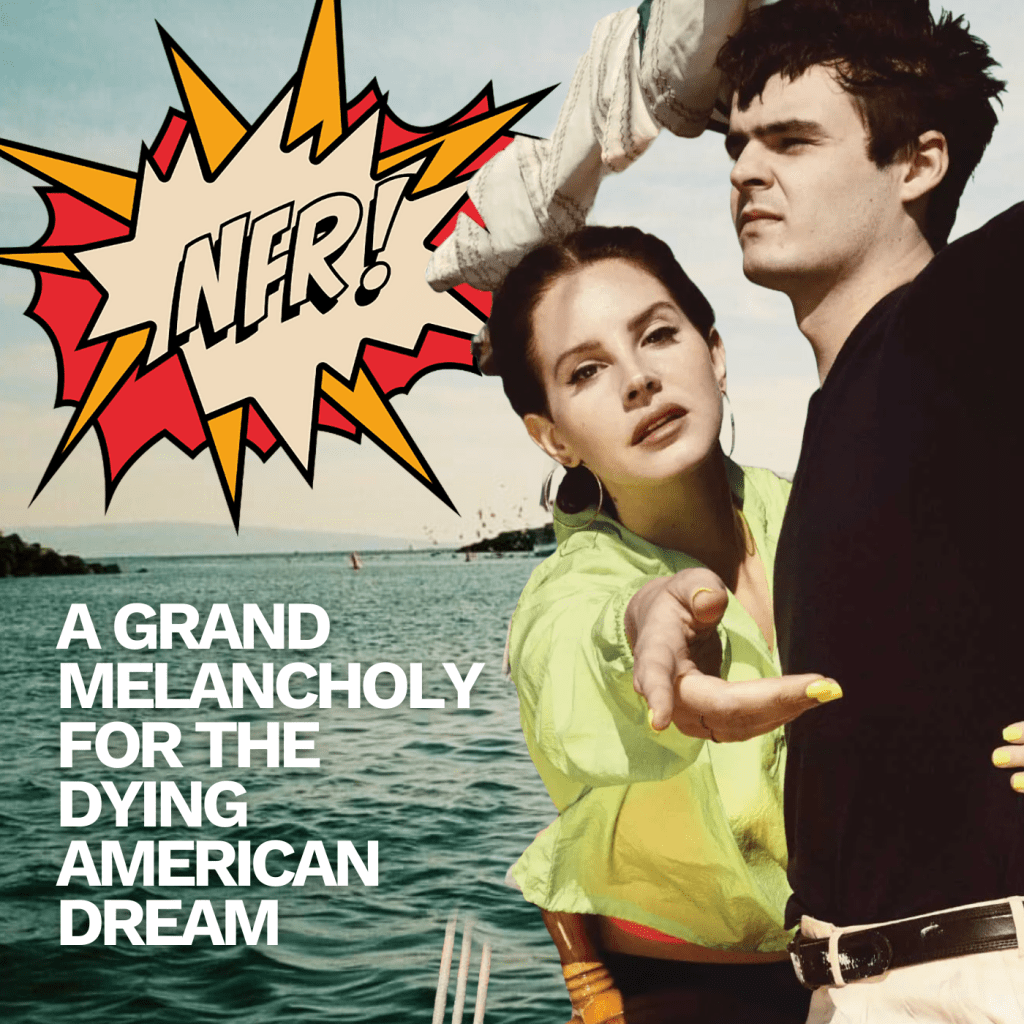
All rise for your new national anthem please. Sounding like a sunrise over the American landscape, the title track Norman fucking Rockwell opens the album with a real presence. Here, you’ve got Lana’s gorgeous vocals floating over soft piano and subtle drums, almost like the calm before the storm. With delicacy and grace, she kicks it off with a the iconic line, ‘god damn, man-child, you fucked me so good that I almost said I love you’ over patriotic-sounding piano chords. Some pure, unfiltered Lana right there. This track isn’t only about a love that’s dying though, it’s growing out of it too. Letting her guard down, Lana sings about a man who thinks he’s all that, but he’s really not: ‘your poetry’s bad and you blame the news.’ She’s growing out of love with somebody (‘you make me blue’), and she’s positioning herself as the next best American songwriter while doing so. Already, we can hear such a change in production here. Her sound and lyrical ability on this dramatic opener lets us know shes trading her previous self for this new persona… and I’m welcoming it with open arms.
Mariners Apartment Complex is Lana at her towering best. Her towering peak. And she’s not just speaking to us, she’s guiding us with this song in a way that makes you feel like you’ve discovered something truly profound about yourself. With a romantic energy, a piano hooks you in, while the turbulent lyrics hit on a summer’s day: ‘you mistook my kindness for weakness.’ Really pushing the boundaries of a singular release, there’s this beautiful balance of melancholy and hope that reflects a lot of Mazzy Star’s work. There’s a healing energy too (‘who I am is a big-time believer that people can change’), as the piano ascends and Lana speaks somewhat candidly. There are 60s guitars, dainty vocals, and a gorgeous overall composition that has us all crying into our margaritas.
Okay, buckle up. We’re diving into the Grand Canyon of Venice Bitch. Standing at 9-minutes, it’s a journey through Lana’s dreamy and disorienting mind. At her most psychedelic, she sings about accepting the chaos of life with the iconic ‘fresh out of fucks forever’. There’s a dreamy mellotron leaning into that surfy California vibe, and by the halfway mark, we’re deep into a full-on acid trip. By this point, the pacing is all off, the keys are mashed, the production is warped and retro, but somehow in the best way. It also showcases a more mature version of Lana. A version where she’s accepting life and becoming wiser, singing ‘you write, I tour, we make it work.’ Frankly, the song really captures the essence of celebrating ordinary life and being okay with just “doing your thing.” We’re 3 songs in now, but already 3 new classics blessing our ears.
On Fuck it I love you Lana really dives into that breezy, carefree feeling once again, but this time with surfy, bouncy beats as she deals with her very own ode to self-destruction. Relapsing and giving in to her bad tendencies, Lana confesses her drug intake is ‘killing [her] slowly.’ This one is an extended trip about addiction, with the dream-like state being intensified by her angelic, high-pitched vocals: ‘turn the radio on, dancing to a pop song, fuck it I love you.’ Or, as she says it, “fuck it I luh yew.” Iconic.
The ultimate reggae-inspired anthem for those summer days, Doin’ Time is Lana’s most radio-friendly cut on the album. Sampling Sublime’s 1996 smash, Lana and Antonoff manage to make it their own, modernizing the lounging sound and bringing it straight into 2019. An effortless, catchy track that solidifies the album’s themes as we progress through it and enter a new era.
With a new dawn rising, Love song is a soft, intimate version of Lana. It’s not a filler track! But it’s also not just a love song! It’s an emotional journey and a soft goodbye wrapped in such a sweet melody. It stands out as one of Lana’s most romantic songs she’s ever written. As I ugly-cry, she hits the ‘oh, be my once in a lifetime,’ and it’s clear that this is a song that requires a quiet listen as she bridges the storyline of looking back at a young love. It’s a top-tier song of hers where you can really feel the weight. Interestingly, it has me wondering if this record is made to make you feel happy or sad. Is it? Yes to both.
Continuing on this piano-heavy act of the album, Cinnamon Girl cleverly has Antonoff holding onto the classic traits of Lana’s work but breathes new life into the composition by pairing it with a backdrop of assets we haven’t really heard Lana sing over. Upbeat production consisting of 808s and classic, royal strings hides the dark undertones, like the bruising imagery in ‘violent, blue-green and red to keep me at arm’s length’, and the bittersweetness and complex layers of love really come to the surface here. This one is clearly about an abusive relationship, with Lana pleading her lover to ‘hold [her] without hurting [her].’ The production swells with uplifting moments and sudden drops that really anchor the complexity of a toxic relationship too.
I’m also theorising the idea of cinnamon here too. Wild, I know. Sure, it’s something sweet and warm to smell, but not necessarily to be consumed. I know this, unfortunately, from the viral cinnamon challenge in 2012. I’m thinking it’s a painful but brilliant metaphor for a relationship that seems perfect on the surface but is deeply flawed underneath.
Exploring the feeling of being unappreciated in a relationship, How to disappear gives off such an exact suffocating feeling. Classical instrumentation makes a comeback again, with disconcerting vibes alongside subdued vocals: ‘you just crack another beer and pretend that you’re still here.’ Feeling resigned, Lana really lets us know she’s dissatisfied in her relationship by looking to escape and disappear, being ignored by the very person she’s giving her all to.
A master of singing about sinister things alongside dramatic orchestral compositions, California sees Lana struggling with the idea of not speaking up when it mattered the most. Almost speaking with a ghost from her past who was clearly suffering (‘I read it in your letter […] I wish you were doing better’), the piano leaves a lot of room in the verses to carry the regret she feels (‘I wanted to reach out, but I never said a thing’). By the chorus, the production swells and really opens up though. Drowning in California’s sunny and drugged-out haze, Lana is the intervention herself, with off-key vocals adding to her desperation, pleading ‘just hit me up’ as a coping mechanism. She’s playing it cool, and the production has a fuzzy, surreal quality that matches the problems of the Sunshine State in its entirety.
‘We’ll do whatever you want, travel wherever, how far. We’ll hit up all the old places, we’ll have a part, we’ll dance till dawn, I’ll pick up all of your Vogue’s.’
Feeling like her own personal revolution, The Next Best American Record sees Lana wrestling with the weight of her memories and the shifting meanings of her past thoughts. Perceived as bad before, the past tense in the verses (‘he was ’70s in spirit, ’90s in his frame of mind’) is sung over simple guitar strums before a dramatic crescendo in the chorus. Alive with life, the chorus is a stark contrast, turning into a dramatic change: ‘whatever’s on tonight, I just wanna party with you.’ A steady beat brings life to this otherwise acoustic track, but it’s definitely a deep cut on the LP.
But here is where she goes really big. The greatest is both my favorite song of hers ever release, and a pure standout on this album. Narrating a world that is collapsing, it’s a testament to life told through an epic, fleeting lens. As nuclear bombs hit the ground, Lana is at her typewriter playing with the HUGE concepts of climate, nuclear war, and political upheaval. It’s her pondering existence. Her doomsday ballad. Her magnum opus. The apocalypse unfolding in front of her, the song’s instrumental is big, bold, and brash, with Lana’s voice soaring above it all, clearer than ever. Reminiscing about life before (‘I miss Long Beach, and I miss you, babe’), the track has an acceptance of feeling helpless, and the chords scaling down really emphasise this too. As we endure the world changing dramatically, Lana resigns and is ‘signing off after all,’ before a 60s-inspired psychedelic electric guitar solo takes over with heavy Phil Collins-inspired drums, carrying on the cultural decline of the track.
This one really captures the failed Americana-style with existential dread and the problems new generations are facing. As her first-ever commentary on present life, the outro is a must-listen:
‘Hawaii just missed a fireball. LA is in flames, it’s getting hot. Kanye West is blond and gone. Life on Mars ain’t just a song. Oh, the live stream’s almost on.’
It’s Lana giving us that helpless ‘fuck it, who cares about all of this’ culture decaying-away mindset. It’s lyrically and production-wise an extremely strong cut that goes somewhere so different that we haven’t heard before. I could talk about it for years. A huge standout.
Offering a break from the heaviness, Bartender gives us a more playful, relatable look at Lana’s life of fame. Fed up with the paparazzi and the noise, she alludes to the idea of just wanting peace and love (‘sometimes girls just want to have fun’). The piano composition here is a real throwback to her early career days, and the whole vibe is like an escape from the chaos. It’s a reminder that fame is not all glamour, for sure.
Happiness is a butterfly is pure Lana. It’s emotional, stripped-back, and absolutely stunning. The bare-bones production, with just piano and her voice, makes this feel like the rawest moment of the album. The butterfly symbolism is so fragile, like happiness itself, as she dances to let that happiness find. Lana lets us know she’s accepting that happiness will come when it comes, being frank with lines like ‘do you want me, or do you not?’ It’s both liberating and theatrical, shifting the narrative away from her lover and more onto her own beliefs.
As we draw to a close, hope is a dangerous thing for a woman like me to have – but i have it ends on a note of brutal honesty, and it’s the most poetic song she’s written. Confronting everything we’ve endured together from this album – from fame to addiction to heartbreak – the final line of the song feels like the culmination of thought and the sadness of her expectations perhaps not being met. Hope is dangerous for her, perhaps due to attachment, or maybe it’s the expected house parties, fur coats, wealth, and tequila not being the exact reality when the rose-tinted glasses are off. Though these realisations are real, Lana is in bittersweet-mode, letting us know over an underwater-sounding piano that she is going to hold on to hope, as she takes us through her dealings with alcoholism, sobriety, reluctance to fame, and escaping the limelight in this ballad form.
This release marks Lana Del Rey’s departure from her previous projects and into her more mature sound. There’s a newfound calmness to the soundscape of this record, with piano-based ballads, soft rock undertones, and the occasional psych-rock jam. It’s very clear that big risks have turned into big rewards. I honestly think it’s a monumental moment for her career – a reflection on grief, lost youth, a longing for a previous version of herself.
Putting this thematically and lyrically into songs is such a hard concept to achieve, but she manages to pull it off with grace as ever. This will go down as a true Lana classic, with its sharp and nostalgic lyrics that capture the essence of pop culture, iconography, and the post-war American dream intertwined with carefully crafted nostalgic production. One of the best albums I’ve listened to, no cap.
 Glerbie