
There’s something delightfully surreal about an album that turns existential dread into a warm, glossy radio show, and yet that’s exactly what The Weeknd manages to do on ‘Dawn FM’. It sits at the centre of The Weeknd’s main trilogy like a dim glow inside a light tunnel. It’s a purgatory broadcast and an in-between world narrated by Jim Carrey, scored by Max Martin’s crystalline pop instincts and co-producers giving it an eerie, digital fog.
Abel appears older on the cover, aged up into a ghost of his future self. It’s theatrical, of course, as everything is with him, but it’s also a thesis statement. This is an album about transition, transformation and reckoning. The sound is cold, neon-lit, and strangely comforting, like someone handing you a warm drink while calmly explaining that you might already be dead. Don’t change that channel, let’s tune in.
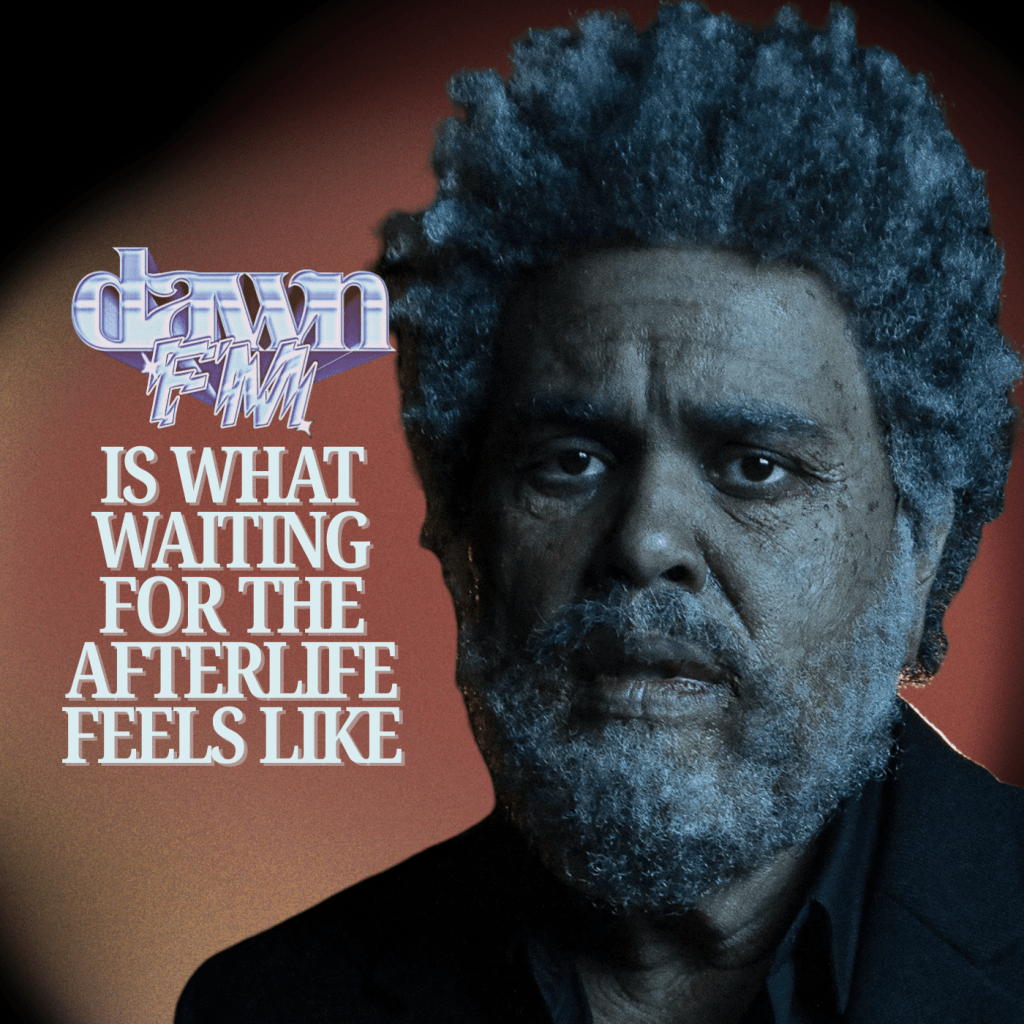
The album (or should I say broadcast) begins with Dawn FM. It arrives, shimmering, on an arpeggiator plate and has the kind of synth that feels like a sunrise flashing through a dirty window. Abel whispers ‘this part I do alone’, a line that lands with the weight of someone talking to their reflection in the mirror before stepping into the unknown, and immediately, there’s a sense of dislocation. The sound is expansive but icy and nostalgically unsettling. It’s clear we’re in for a ride.
Jim Carrey drifts in, soft and serene, like a cosmic radio host guiding you through the afterlife’s hold music and the production leans into an 80s fantasy-soundscape. Full of echoes but eerily calm, it’s like we’ve stumbled into a broadcast we’re not supposed to hear. He concludes ‘you’ve been in the dark for way too long’, and I’m still unsure whether this is comforting or a threat, but it really sets the stage beautifully for the LP. Engines warm, lights buzz, and suddenly, we’re in.
Tumbling into the abyss, Gasoline wastes no time pulling the rug out. It launches us into spiraling synths, rubbery basslines and a pitched-down vocal that makes Abel sound like he’s singing from inside his own shadow. It’s disorienting, theatrical, and intoxicating. Abel starts with ‘I’m falling into emptiness, I’m falling into the abyss’, muttering nihilistic claims that are even more chilling than the chaos around him. The classic bleakness of The Weeknd is right here but it’s warped this time. Instead of suffering through falsetto glamour, we get a numb, dead-eyed persona watching themself dissolve. By the time the chorus loops back around, it’s clear that this is not the Starboy we once knew, but this is the soul wandering after the star burns out. Oooft.
As this bad trip unfurls, How Do I Make You Love Me? becomes claustrophobically tight and warm. R&B-slick at first, the track then becomes breathless and urgent, each repetition of the title line sounding a little more desperate and a little less tethered to reality. Synths escalate into something more triumphant and hallucinatory, paying homage to ‘The Final Countdown’ by Europe, but it’s much more twisted here. Sprinting through a neon labyrinth, this track is chasing the idea of love rather than the person themselves. The question turns manic in its looping but then eventually dissolves into chant-like spirals of dissociation. By the outro, the world feels titled like a Vice City alleyway at 3am.
Out of the psychedelic haze and into a euphoric release, Take My Breath enters like a DJ set finally catching its groove. The extended intro is a slow build full of plucky guitars, descending chords and layered synth stacks before Abel cuts through with ‘I saw the fire in your eyes’. Suddenly, we’re in the familiar version of The Weekend – a disco-pop triumph that feels like the album finally remembering how to breathe. This is where his Michael Jackson likeness shines brightest. The energy, elasticity of the basslines and confident falsettos add a real sense of pure, shummering dancefloor euphoria and the song plays like a tension release after the suffocating first act.
If that was the high, Sacrifice is the low that follows. Guitars slice through the beat with a gritty funk edge, immediately recalling MJ’s Thriller era, just with more dystopian feelings. Here, Abel plays the role of someone bargaining with temptation: ‘you’ll always sacrifice your love for more of the night’, he sings. Not in an accusational tone, but one that’s confessional dressed up as a pop hook. The song lives as a push-and-pull, with the desire to indulge as the fear of losing yourself becomes more and more apparent. Retro Italo-house chords come to life, but the production makes it feel like it could belong in 1985 or 2085. The entire track has the mood of someone walking into danger with full awareness but the beat too irresistible to resist. A great follow-up single.
A Tale by Quincy then serves as a pivot of wounds and wisdom. The glossy façade cracks and you see the scaffolding beneath the persona here, with Quincy Jones speaking about childhood trauma, failed relationships, and the way emotional wounds linger long after the world expects them to heal. The plucky guitar and gentle arrangements contextualise the fear of vulnerability, the cycle of self-sabotage and the way desire becomes a shield against loneliness. And in an album about purgatory and transition, this interlude feels like a confession booth. That is… right before the radio jingles bring us right back anyway.
Heartbreak settles in Out of Time, as this one is a breath of soft, nostalgic air. Sampling a Japanese city-pop record, this is Abel’s warmest vocal performance on the album so far. It feels like you’ve exited the neon tunnel for a moment and stepped into a golden-hour. Lyrically, it unmasks as The Weeknd confesses mistakes, admits betrayals, and comes face-to-face with the reality that he’s too late, repeating ‘say I love you girl, but I’m out of time’. It’s simple, devastating, and delivered with such a clarity. Production wise, I’m always here for tambourine shimmers, but pair this with a smooth bass and glossy synth flares and this feels like drive-time radio. Gorgeous.
Jim Carrey returns to close the track, guiding the listener gently but firmly back toward the purgatory narrative, like a hand on the shoulder nudging you toward the light you’re not sure you want to reach, before the transition hits…
Here We Go… Again feels like a surreal recap montage, life flashing in slow-motion. You know the kind that you think will play in your mind when you’re dying? There’s a choral, gospel-tinged warmth to this arrangement with soft organ chords and floating harmonies, and it’s paired with a heavy, playful bassline that keeps everything grounded. Reflecting on his triumphs and contradictions in life, Abel talks global stardom, artistic reinvention, the Super Bowl spectacle and the highs and lows of being star he is. It’s a song that feels like someone looking down at their own life from a distance. Tyler, the Creator then steps in with his signature humor and cynicism, giving the track another layer of self-aware commentary. The whole song spills like a freeform thought and it’s the closest we get to a victory lap on this album.
Immediately though, we’re thrown back into club lights and sweat-slick tension with Best Friends. Toxic in its address, basslines punch forward with a rhythmic urgency and get paired with chords that feel both playful and sinister at the same time. This is Weeknd’s specialty – danceability masking emotional collapse. He repeats ‘you’re my best friend now’ in the same breath of ‘I love it when we climax’, so it’s clear there are definitely some crossed lines going on here. The lyrics are blunt and wounded, painting a picture of two people trying to detach even as they orbit each other and the paradox here is a beat that makes you move with lyrics that make you wince. Never-stopping, messy, human, and painfully self-aware.
Abel then re-enters with familiar terrain in Is There Someone Else?. Full of suspicion, insecurity and the nagging fear of being replaced, his voice is feather-light but strained, exploring the tension between wanting the truth and fearing it. He claims ‘I know you’re hiding something from me’, as the chorus blooms into one of the catchiest melodies on the album. Heartbreak tends to arrive dressed as a pop gem on this album, but the knife twist is once again the self-awareness, shown through lyrics like ‘I don’t deserve someone loyal to me’.
A fragile echo to this, Starry Eyed, feels like the ghostly counterpart in a softer, more intimate state that hovers over an eerie landscape. The synths dip beneath the surface here, giving the entire track a submerged quality, as Abel confesses ‘you were there for me when I needed someone’. The tenderness is new here, threaded with melancholy. Almost like love remembered, not lived, as it flickers out into the abyss. It’s a short track, but it feels like a breath held too long.
Into the cosmic rupture, Every Angel is Terrifying sees the album catapult into full surrealism. Beginning with dissolving synths and celestial choirs, Abel recites lines that feel plucked from a metaphysical poem like you’re meeting your maker. He states ‘beauty is the terror we endure’, as the album snaps into a sharp moment of relief. Themes of annihilation, awe and surrender come to play, but in a second of whiplash the song morphs into a bizarre radio commercial advertising the afterlife like a vacation package. It’s absurd, hilarious, unsettling and completely commercialised. The ad promises afterlife is ‘intense’, ‘graphic’, ‘sexy’ and ‘euphoric’ as if it were a product. Pure Black Mirror-esque. It’s the album’s strangest moment and also one of its most thought-provoking in how we want to purchase comfort at all times.
This collapse softens in Don’t Break My Heart, as Abel gets vulnerable in his pleas, wrapped in low-end warmth and hazy synths. The production removes the high-end sheen, leaving a darker, more intimate sound that feels like a private moment in a crowded room and Abel says he’d ‘rather die at the discothèque’, giving the idea that heartbreak can be fatal but at least you’re dancing. It’s a come-down song, the moment after adrenaline fades and the emotional bruises begin to bloom, and the simple ‘don’t break my heart’ repetitive hook gives this song a fragile breath before the final stretch.
Looking into the rearview mirror, I Heard Your Married sees Abel step back into a more narrative mode with Lil Wayne as a feature. Tied to a lover he thought he had a future before realising they are now married, The Weeknd takes us through the emotional debris in this track. Production leans into early-2000s shimmer with rubbery bass, crisp claps and a slightly retro casing, but the lyrics have a lot of resignation still (‘I knew that this was too good to be true’). It’s another reminder that this record functions as a reckoning life-review set to the backdrop of incredible synths.
Seeing the sunrise finally, Less Than Zero is the most uplifting moment on this release. It’s a track drenched in warm acoustics, chiming synths, and an 80s brightness that recalls early David Bowie. It’s a sunrise and the first true sign of light after a long, neon-lit night of purgatory. Abel states ‘I wear your heart like a symbol’ in an earnest way, and there is such a clarity in his voice. This is a real striking moment after so many distorted personas and shifts throughout the album. It feels like Abel is stepping out of costume, letting himself be human again. The melody is infectiously sugary and carry a bittersweet edge of someone trying to heal themselves, grappling with old patterns. It’s the end-credits moment of the album, still giving into tenderness, but it’s an emotionally satisfying release from tracks filled with morality and regret.
In the final passage, Phantom Regret, Jim Carrey returns to close the album with a gentle, poetic monologue. Part spoken-word, part prayer, part existential lullaby, this track feels like the back rooms in a liminal space. It’s atmospherically soft with holistic lines like ‘heaven is for those who let go of regrets’, summing up the emotional architecture of the entire album. It’s an invitation to release the pain we cling to and an encouragement to shed the ego we hold like an old coat. A really human-like ending to this release.
The glowing heart of ‘Dawn FM’ stands as The Weeknd’s most daring and balancing act: a concept pop album wrapped in existential dread, a record disguised as a radio show and a purgatory journey that manages to shimmer with life. It’s a story framed with love and self-destruction told through neon synths and anxious grooves, proving that Abel still has the knack to glamorise the darkness alongside interrogating it too. It became clear to me after listing this album that it was never about death after all but more about transformation. About the courage to face yourself before the light arrives. Blimmin’ deep, that. Big bravo.
 Glerbie