
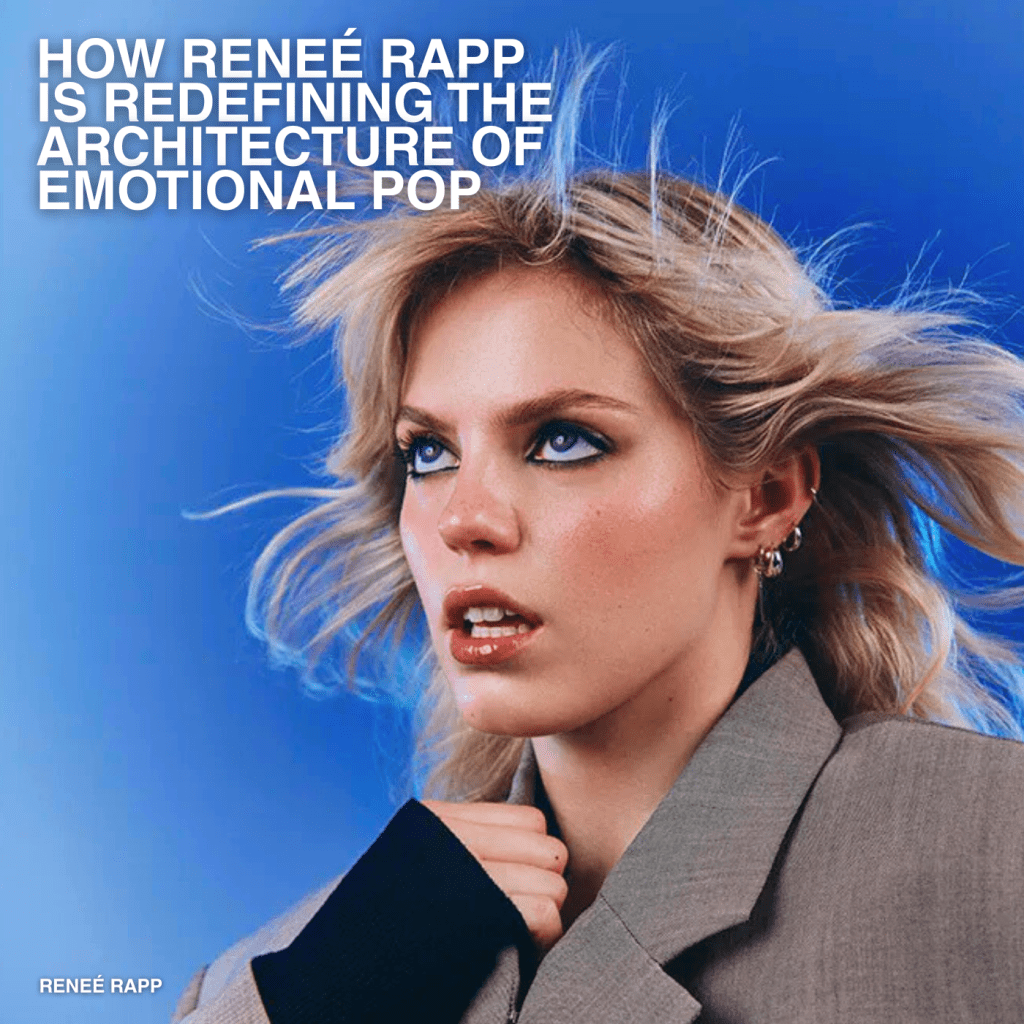
I’m sitting here, freshly recovered from a weekend of too many main character moments, wondering if I, too, should move to Boston and become the problem. Cue the entrance of the stunning Reneé Rapp. You may have seen her in the popular TV show ‘The Sex Lives of College Girls’, but her transition to solo-pop powerhouse has been nothing short of a cultural reset. This release is a vocal clinic for Gen-Z divas. She’s really that bitch.
Collaborating with Alexander 23, Rapp has cautiously crafted a project that is equal parts Broadway and rock-infused. It’s raw, it’s honest, and it’s oozing with a level of sex-on-legs confidence that only a true new pop icon could pull off. Let’s break it down.
The opener, Talk Too Much, hits like a shot of adrenaline. It starts with a questioning, nervous guitar and some sexy breathwork in the intro that gives it a muted feel as Rapp sings, “tasted the blood on my mouth.” It’s intimate but edgy. Within the 60-second mark, crunchy guitars rip the band-aid off, and suddenly we are in a full-blown pop-rock anthem. The production shines here, giving the track an overdriven, detuned guitar centre stage and a bassline with a groovy simplicity, mirroring Reneé’s self-sabotaging internal monologue as she sounds sliiiiightly hungover. Whilst the chorus gives us a masterclass in red-flag behaviour (“I think I talk too much”), it’s the bridge where the real magic happens. It builds into a chaotic, honest ramble of whispers with megaphone tones and hush-hush secrets that feel like many thoughts happening at once. It’s messy, it’s loud, and it perfectly sets the tone for an album where her own brain is her biggest obstacle. Those red flags? I’m saluting them.
Pivoting 180 degrees into a sarcastic, melancholic breakup anthem that is so charming it actually hurts, I Hate Boston starts simply with just a piano. Reneé leans into her musical theatre roots to deliver an intimate performance where you can literally hear the heartbreak in the studio. It’s a complete departure from the opener, trading the crunch for a dramatic, orchestral sweep with charming vocals and a melancholic delivery. The songwriting is signature Rapp: witty, overstated, and deliciously dramatic. Claiming you should “burn the whole city down” just because an ex lives there is the level of pettiness I live for, and the “hid me in your basement, god forbid you’re not the center of attention” line really cuts like a knife. Just as you think you’ve got the vibe, the song explodes into a crescendo of live drums and orchestral “ahhh’s” while Reneé ramps it up into her head voice: “oh, when you held me hostage, you must be exhausted, don’t you miss me?” It then dampens down again into a sweet, stripped-back outro that leaves you breathless. Stunning work.
If the previous track was a tear-jerker, Poison Poison is a bossa nova recovery fever dream from hell. We’ve got acoustic, boppy arrangements and Spanish elements that feel light, matching Rapp’s witty lyrics, making lines like “you’re the worst person on earth” even more hilarious. It’s a confrontation wrapped in a fun, rhythmic package. With its R&B influence, Reneé claims “it didn’t have to be like this,” and the backing vocals sound like a group of girls in a high school bathroom plotting against a common enemy together. The hyperbolic language, claiming someone is “so fucking annoying [they] could poison poison”, is a top-tier claim too. Bravo. The bridge takes a dark, Billie Eilish-style turn with a wubby, half-time drum beat and a bass-boosted layer, shifting the tone from playful to pointed, but humour is still evident in the outro with lines like “I think you should shut the fuck up and… die”. It’s clear this is a jokey song about karma that feels like a toxic little treat, though I feel there must be some unresolved trauma deeper here…
Now, I’ve only recently become ‘at one’ with my emotional wellbeing, but Rapp really takes it to a celestial level on Gemini Moon. It’s a track that uses astrology to depict instability, and Rapp gives us insight into her mind through oxymoronic lyrics like “you never know who you’re gonna get […] sour lemons or cinnamon”. She perfectly captures this duality. The verse structure feels like a tense back-and-forth itself, with an inquisitive guitar leaving enough room for her to admit she’s the “problem kid,” too. The music cuts out just before the chorus, and suddenly that shift opens up fully with Reneé pleading, “I bet you’re sick of it, believe me so am I.” I’ve never heard a tambourine feel so essential in a mix. It’s like a snap of realization. The production swells, the synths start to rinse, and the instrumentation offers a lot more clarity. It’s cold, poignant, and incredibly self-aware. Queen shit.
Brace yourselves, because Snow Angel is hands down the best on the album and the song that got me into Reneé Rapp. It still blows my socks off every time. We start with a fragile, toy-box vocoder and a warm piano, with Reneé’s falsetto sounding like it’s made of glass: “first to arrive, last to leave.” It’s melodic storytelling that you already know is going to hold a lot of weight. But then? Her shocker “I’ll make it through the winter if it kills me” launches us into the stratosphere with a Queen or ELO-esque production that is absolutely MAAAASIVE. I’m talking 15+ tracks of production, heavy guitars, and a vocal belt that could power a small city. It’s dynamic and dramatic as Reneé addresses her 2022 drugging incident with a level of raw power that feels like a reclamation of her narrative. Lyrics act like a physical weight bringing her down, emotionally draining herself further saying “seasons change, addiction’s strange,” providing a survival narrative wrapped in a cinematic coat of white snow. It’s the heart of the album, and it’s where Rapp proves she’s not just a singer, but a storyteller of the highest order. Goosebumps for real.
Following this was always going to be hard, but we move from musical theatre to pop-country and a surprising twang that works perfectly in So What Now. This one addresses past lives and the difficulty of navigating new industries while trying to break the mould (exactly what she’s trying to do). Pulsating warm synths and acoustic guitars give this track a freeing, ‘coming back home’ feel and lyrics describe that awkward aftermath of a breakup in a shared city, seeing a “friend of a friend” and wondering if, “should [they] run into each other on the street, should [they] should keep walking.” It’s a safe, rooted production that acts as a palate cleanser after the high drama that preceded it.
Still on somewhat of a high, The Wedding Song is the literal epitome of the perfect love song. Only thing is, it’s actually about the ‘could-have-beens’, as Reneé gives us insight into her lover letting her down. The track is crafted with such excellence, featuring gentle harp plucks that breathe life into the wedding imagery before it completely explodes in the chorus. And we fly. Boy oh boy do we fucking fly. Reneé lovingly belts, “you are my one, you set my world on fire,” over major chord moments supported by harmonies as strong as the Golden Gate Bridge. The middle-8 of this song itches every single spot in my brain too, with her line “why’d you have to burn it all down?” having such a stunning tone. Slide guitars enter to give this a Texan, big-sky feel and the whole production has an early 2000s nature about it. A story about a romance destroyed before the ‘I do’s’, and every part feels perfectly intended.
Acting as her mainstream breakthrough, Pretty Girls serves for a good reason. Phenomenally sexy and capturing a specific Gen-Z social dynamic, this one is all about straight girls hitting on queer girls as a form of experimentation for want of a better word. With razor-sharp criticism, it’s a catchy number that sounds like an 80s Sunset Boulevard drive with the top down. Beneath the loud synths though, there’s a bittersweet feeling of being objectified (“they’ve got to have a taste of the pretty girls”). Bi-curiosity is real of course, but the see-saw of being flattered by a flirt or being used as a prop is a real concern, and Renee delivers this all over a Taylor Swift-toned maximalist track to make it known.
Getting into an R&B, SZA-esque flow now, Tummy Hurts is a real groove. This one opens with the iconic one-liner, “maybe I should try religion ’cause Jesus you’re hard to rely on.” Lol. Reneé captures that literal sick feeling of jealousy and the emotional linger after a breakup on this record. It has a nostalgic sound with such a seductive bassline – I can really smell the candles on this one. It’s about observing from the sidelines as an ex moves on, with Rapp warning, “someone’s gonna hurt their little girl like their daddy hurt me.” It’s deep, physical and somewhat cyclical.
Heading into the last chapter and acting as a gorgeous campfire song, I Wish is a delicate, intentional strumming track that still manages to feel like a punch to the gut. It’s about the loss of innocence and the terror of losing loved ones. One-liners hit deep: “how could the person who taught me to breathe take their last breath right in front of me?”, and the he production is echoey and distant as if Reneé is looking down from the tesseract of life. It’s the quieter masterpiece of the album.
Lending from similar themes, Willow is the apology Reneé wants to give to her younger self. There’s a cute toy piano intro and a dreamlike synth that creates a resilient atmosphere as she persuades “don’t cry Willow, I’ll cry Willow.” The track explores how Reneé is taking on the responsibility and guilt of her past so her inner child doesn’t have to anymore and the guitar playing on this one is gorgeous, the cajón drum also giving it a grounded, organic feel.
We then get a precious, bubbly, and raw look through the yearbook on the outro, 23. On the verge of her birthday, Reneé admits she “still can’t fly” and feels like everyone in her life hates her. It’s that early-adulthood crisis where everything “looks good on paper”, but the internal reality is a mess. It has a realism vibe about it, and Alexander 23 leaves plenty of room for Rapp’s lyrics, with the piano being the only major influence. It’s a gentle, rocky end to a whirlwind cathartic release.
Reneé Rapp has really and truly hit the ground running with this debut. It’s a genre-hopping release, but that’s exactly why it works. It’s a nuanced, robust collection of ballads and stadium anthems that sparkle with Reneé’s personality and her sheer versatility. Her vocals are a powerhouse, the production is tight, and the storytelling is top-tier. Triple threat. She’s found her sound by trying everything, and the result is a cultural moment that feels both intimate and massive. Such a strong entry.
 Glerbie