
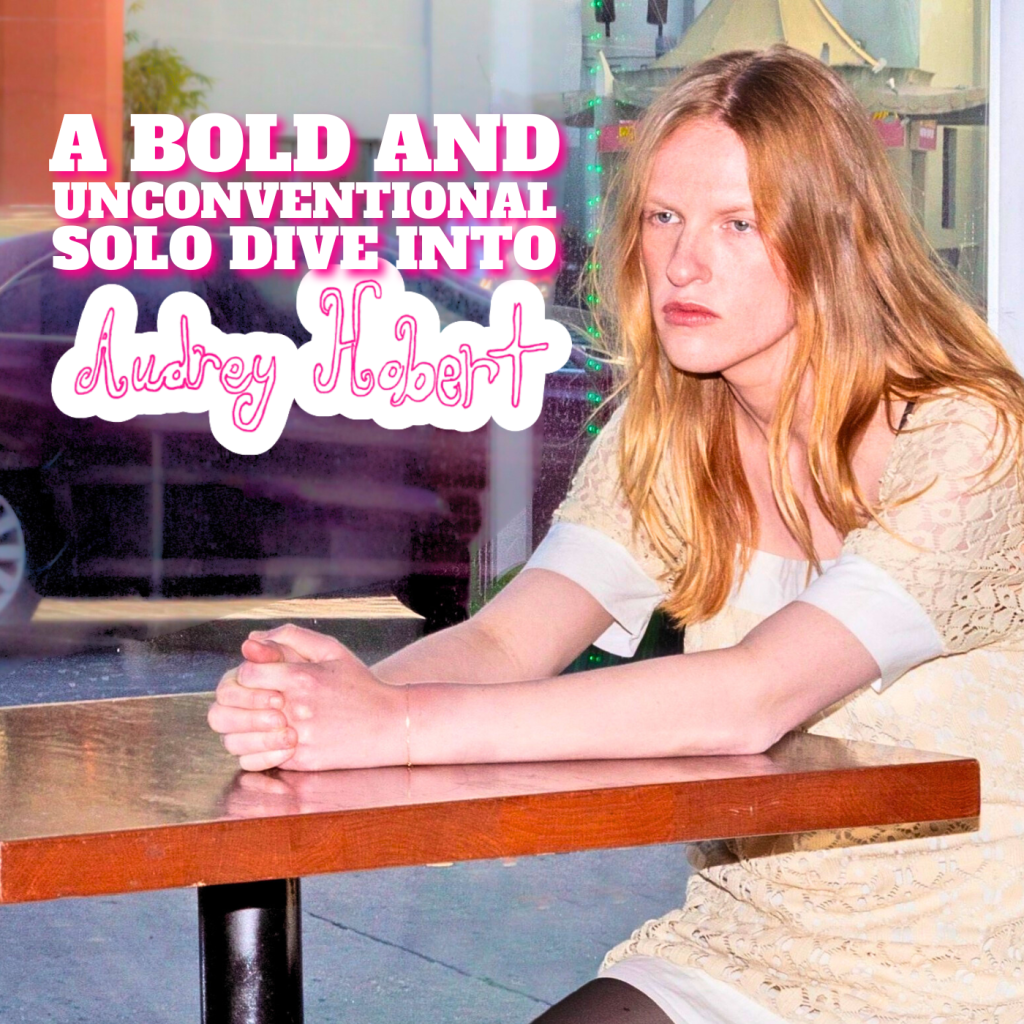
Best known, so far, for her work with Gracie Abrams, Audrey Hobert has stepped into the solo spotlight with her debut ‘Who’s the Clown’, and it’s as messy, confessional, and chaotic as we could’ve hoped for. Her scatty but flourished vocals pair with singer-songwriter sensibilities, producing something that’s immediately intimate but strikingly new for our ears. She’s really our unconventional girlie. Based in NYC and a sibling of fellow-musician Malcolm Todd, she teams up with longtime collaborator Nicky Gourmet (known for working with Finneas) to craft this personal, often hilarious, but always honest debut. It’s a kaleidoscopic glimpse into Hobert’s mind and the messy brilliance of it all.
The album kicks off with a confession so candid it’s almost embarrassing… I like to touch people. Hobert’s acoustic guitar strums gently before a backbeat crashes in with no warning or ceremony. It’s just a pure, unfiltered honest opener. Underneath the simple composition lies subtle irritations from growing up with a ‘people-pleasing mother’ alongside nostalgic traits dripping with early 2000s vibes. Soon after, we hear those signature “woos” that Hobert is so well known for, and we’re thrown into this absorbing soundtrack where her heart is really on her sleeve.
Flipping the switch, Sue me serves as the album’s lead single and let me tell you… it’s a fricking pop smash. Built for virality, this track is filled to the brim with huge synths, infectious energy, and chaotic collisions with playful, tongue-in-cheek lyrics. It’s a desperate, crowd-pleasing catchy tune where Hobert repeatedly spills ‘sue me, I wanna be wanted’ over a pulsating synth. God forbid somebody recognises her! Hobert’s vocal ability becomes super apparent in the bridge of this one, where she humorously apologises ‘sorry that your dog died, sorry I’m not your dream wife’ before climbing the octaves with her post-chorus riff. She is wanting to spill her heart out here. She’s going to cross those lines. And the music video is also a great depiction of this aimless, freeing personality that we’ve come to known and love already.
On Drive though, Hobert turns disaster to rhythm, and ‘another disappointing night’ to autopilot survival. Heavy basslines and fast-paced lyrics propel this track forward, echoing the struggles of social navigation as she tries to ‘play it cool’ and go with the flow over a hypnotic, driving (see what I did there?) beat. Hobert is rejecting modernity here, capturing that overspilling vibe again but this time just moving on with it. She is fleeing the nepo baby narratives, waking up from ‘a nightmare where [she] loved a socialite’. And whilst monotonous in tone within the chorus but rich in colour and texture elsewhere, the song perfectly captures someone moving forward with blinkers on despite frustration (‘sometimes it’s all you, all that you can do’). Totally captivating.
Then, homemade guitars set a loose, intimate stage for Wet Hair, where Hobert explores the messy art of trying not to care over what sounds like – to me – a simple Garageband loop. Rekindling with an ex, she performs casual bravado with a conversational tone – ‘sad old me showed up with wet hair like it didn’t matter and I didn’t care’ – all while over analyzing her inner monologues. She is literally constructing the unbotheredness. Queen shit. Hobert alludes to drinking to ‘feel normal’ and ‘shooting the shit’ like it’s nothing, and she builds a humorously scattered landscape – ‘you’re taller than I can recall, like, when did you get so tall?’ – with melodies dancing over repetitive guitar riffs. Her mind is everywhere and it’s beautifully human. A masterclass in surface-level coolness. An A+ in concealing the inner psyche. And a personal stand out for me.
Building on this naivety, Bowling alley navigates social anxiety with frantic precision. Over jumpy and acoustic strums, Hobert paces between wanting attention and resisting it through cold feet, cycling with high-tempo, confessional bursts that pretty much mimic a panic attack: ‘your shit’s all twisted, everything’s off’ and ‘it’s a choice or I’m cursed’. Y2K-tinged melodies and Avril Lavigne-coded phrasing really heighten this rocky tension, and the cyclical nature of the song mirrors the ups and downs of social life as she comes to the conclusion that ‘everybody loves me but doesn’t need to be around me all the time’. Attention in small doses is key for our Audrey. By using the bowling alley as a metaphor for social exterior situations, and her bedroom as a comfort zone, Hobert has the ability to interrogate the environment to show a striking awareness of her own place in the spotlight. today. Big sentence, sorry. This track also really shows off Hobert’s clear, clean and vivid voice. It’s such a refresh from what we know.
But then by Thirst Trap, it’s clear to hear that we’re entered a new era. This is Hobert doing things she doesn’t usually do: ‘so I’m crazy, that’s usually not my thing’. It’s a new persona with new expectations and the production has also taken a shift too. We’re in new territory now, with heavy drum hits, striking piano chords, backing vocals, and a “fuller” production layered onto the acoustic foundations we’ve heard so far. This is Hobert wrestling with her identity (‘fighting for my senses’), reflecting on her upbringing and creating a new, magnetic persona that differs from her ‘lame’ self.
‘I’m not what I used to be, and you don’t want me, it’s easy to see,
and I’ll move on eventually, but for now, I’m taking pictures
Diary-entry like storytelling shows Hobert confronting herself while inviting the world to watch, with her new aura striving to be noticed now and taking thirst traps are the perfect gateway to achieving this. Sidenote though: the explosive sax solo at the end deserved way more than the 21 seconds it got. Give it a spin.
Dialling it down to a 101 in observation, Chateau is just gorgeous. Set in LA’s legendary Sunset Strip, Hobert witnesses wealth, performativity, and pretense with a real detachment. Rich, silky production and strummed guitars convey luxury, while her lyrics dissect the reality of the scene through comparative lyrics like ‘high school was better than this’. Detached and sharply witty, Hobert refuses to be impressed, longing for authenticity amid this superficial and hyperbolic landscape. The chateau literally takes desired life to the extreme and Hobert is a fly on the wall in this situation as she breaks down an industry party and paints it as melancholy. It’s a real statement on status – who you are vs. who you’re with – and the final chorus’s rocky crash-out adds an emotional edge that really showcases Hobert’s varied vocal profiles.
Reality checking on us, Hobert quickly undercuts fantasy from the start in Sex and the city. She quite literally opens with ‘this isn’t sex and the city, nobody’s watching me write in my room’. This track is all about the small feats that become monumental. The mundane actions that turn into confessional storytelling. And it’s an narrative-based, heart-wrecking song about love and desire. Audrey almost to act almost with Sim-like qualities over a track that has gloomy synths and percussive builds to intertwine with her thought processes. Superstitious at times (‘if it’s not in the stars then I don’t want it either’), Hobert is coming to her senses in her Uber ride home, dealing with escapism through drunken and unpredictable highs and lows: ‘he’s the love of my life, no he’s not’. The song’s precise lens turns ordinary life into a compelling musical drama as she is almost re-telling her struggles in real-time too.
Shooting star is the one track that really got me obsessed with this little ginger girl. Calling me a bitch in the intro? Check. Heavy synths? Double check. This cut is pure obsession material, with Hobert opening up with spiritual, rising synths that signal indecision in a nightclub, all whilst being able to separate herself from her own narrative. Filled with third-person storytelling and social commentary, Hobert runs us through a night out that’s surprisingly self-aware and poignant through lines like ‘when I’m drunk at the club I wanna be felt up’. But she’s also been here before, seeing through the haze of drugs and delusion, by giving her friends cut-throat advice like ‘girl that’s not a shooting star’, that gives her the upper hand on seeing through the so called “rarity” of some men. Preach.
An anthem of friendship and grounding responsibility, Don’t go back to his ass is a twangy, country and chant-like track to resist your ex. Setting the stage, Hobert’s friend is clearly delusional and this track aims to deliver and remind her of all the red flags – ‘I know it’s hard, I know he’s funny, but baby don’t go back to his ass’. Harmonically rich and swingy, it’s a fun and wise track with a powerful and honest reminder throughout. A timeless classic and I personally adore the ‘city smells like gin and tonic’ line. 10/10.
Then comes our raw and honest beloved, Phoebe. Inspired by the odd-one-out archetype that Lisa Kudrow portrayed in the 90s smash ‘Friends’, Hobert challenges the standards society sets for women, opposing the dazzling standards, and claiming ‘who cares if I’m pretty, I feel like I’m Phoebe’. An upbeat, country-tinged guitar juxtaposes with gut-wrenchingly open and introspective lyrics as Hobert relives past wounds but still emerges confident (‘why else would you want me, I think I’ve got a fucked up face’). She stands on business being herself, saying she ‘fell in [it’s] sweet embrace’, and it’s clear that the track is a celebration of loving the mismatch and a vibrant reminder that identity isn’t about perfection but rather authenticity. Gorgeous.
After this heartbreak moment, the album closes with an anthem to Hobert’s 25-year-old self, Silver Jubilee. It’s a triumphant, synth-heavy and rock-infused closing track that celebrates growth, freedom, and self-reinvention. Hobert throws her own anniversary for her 25th and it has a freeing, letting go quality: ‘imma live it up like my life starts now’. The 90s rock and stadium-worthy sounds create a feeling of resilience and Hobert delivers life lessons in manifesto-form: ‘blink and you could miss it, it’s over, it’s alright’.
It’s a perfect time capsule for this release – turning experience into empowerment – and marking the beginning of a bold new chapter. This album teaches you lessons, now apply it to yourself and go and live.
Well and truly, Audrey Hobert’s craft is deceptively simple yet emotionally complex. This release is messy, odd, hilarious, and confessional with each track acting as a document of human experience told through honesty and wit. She has a way of speaking simply about complex situations, and it has me questioning who really is the clown? Is she the clown going against the grain, or are we the clowns blinding following the norms of “cool”?. A lot of finger pointing going on here. Is cool lame and is lame in right now?
It’s an emotional album told from the sidelines, as Hobert manages to separate herself from concepts that act as rituals almost as if she’s reporting for a documentary on human experiences. It’s honestly an incredible debut with some real unique numbers all wrapped into a cohesive project. Such a memorable release with a big and unforgettable impact. Repeat factor goes crazy too. Bless your ears.
 Glerbie